Did you know that using the wrong recovery method could void your vehicle’s warranty or cause thousands of pounds in drivetrain damage? If you’re currently stranded on a busy motorway or stuck in a car park, that’s the last thing you need to hear. You’re likely feeling the pressure of making a quick decision whilst worrying about the safety of your car. It’s a stressful situation, and you want to ensure your vehicle is handled by experts who won’t make a bad day worse. This is why flatbed towing has become the mandatory standard for modern vehicle recovery.
We’re here to provide the proactive relief you need. In this guide, you’ll discover why flatbed towing is the safest method for vehicle transport and how to choose the right recovery service for your car or van. We’ll break down the technical benefits of total-lift recovery, from protecting electric vehicle batteries to ensuring damage-free transport for prestige cars. You’ll learn exactly what to look for in a professional service to ensure a quick response and a secure journey for your vehicle.
Key Takeaways
- Learn why the hydraulic total-lift method is the gold standard for protecting your vehicle’s drivetrain and bodywork.
- Understand the risks of traditional recovery and how to avoid accidental damage to your car’s undercarriage.
- Identify why electric cars and AWD models strictly require flatbed towing to prevent expensive mechanical failure.
- Follow our clear breakdown of the recovery process to ensure your safety whilst waiting at the roadside.
- Discover how a national 24/7 service provides the immediate, professional handling you need during a breakdown.
What is Flatbed Towing and Why is it the Gold Standard?
A flatbed recovery vehicle, commonly known as a rollback lorry, represents the pinnacle of vehicle transport technology. It features a long, level bed that serves as a mobile platform for your car or van. Unlike other methods that leave half the vehicle trailing on the tarmac, this approach ensures the entire weight is supported by the lorry’s chassis. Professionals consider this the “gold standard” because it removes the variables that lead to accidental damage. When you choose flatbed towing, you aren’t just moving a car; you’re protecting an asset.
The primary benefit is the total elimination of road contact. When a vehicle is towed with two wheels on the ground, the tyres, suspension, and transmission are still subjected to the stresses of the road. On a flatbed, your vehicle is a passenger. This method removes the risk of stones flicking up into the undercarriage or the bumper catching on a high kerb. It’s the most composed, solution-oriented way to handle a breakdown, ensuring that a mechanical failure doesn’t turn into a bodywork repair bill.
The Mechanics of a Rollback Lorry
Modern rollback lorries use a sophisticated hydraulic tilting mechanism. The operator initiates the system, causing the entire rear deck to slide backwards and incline until it meets the road surface. This creates a ramp with a very shallow angle, which is essential for lowered cars or vehicles with long front overhangs. If your engine won’t start, the driver uses a heavy-duty winch to pull the vehicle safely onto the deck. Once positioned, the bed levels out and locks into place. This creates a rigid, secure environment that prevents the car from shifting during the journey.
Flatbed vs. Traditional Recovery Methods
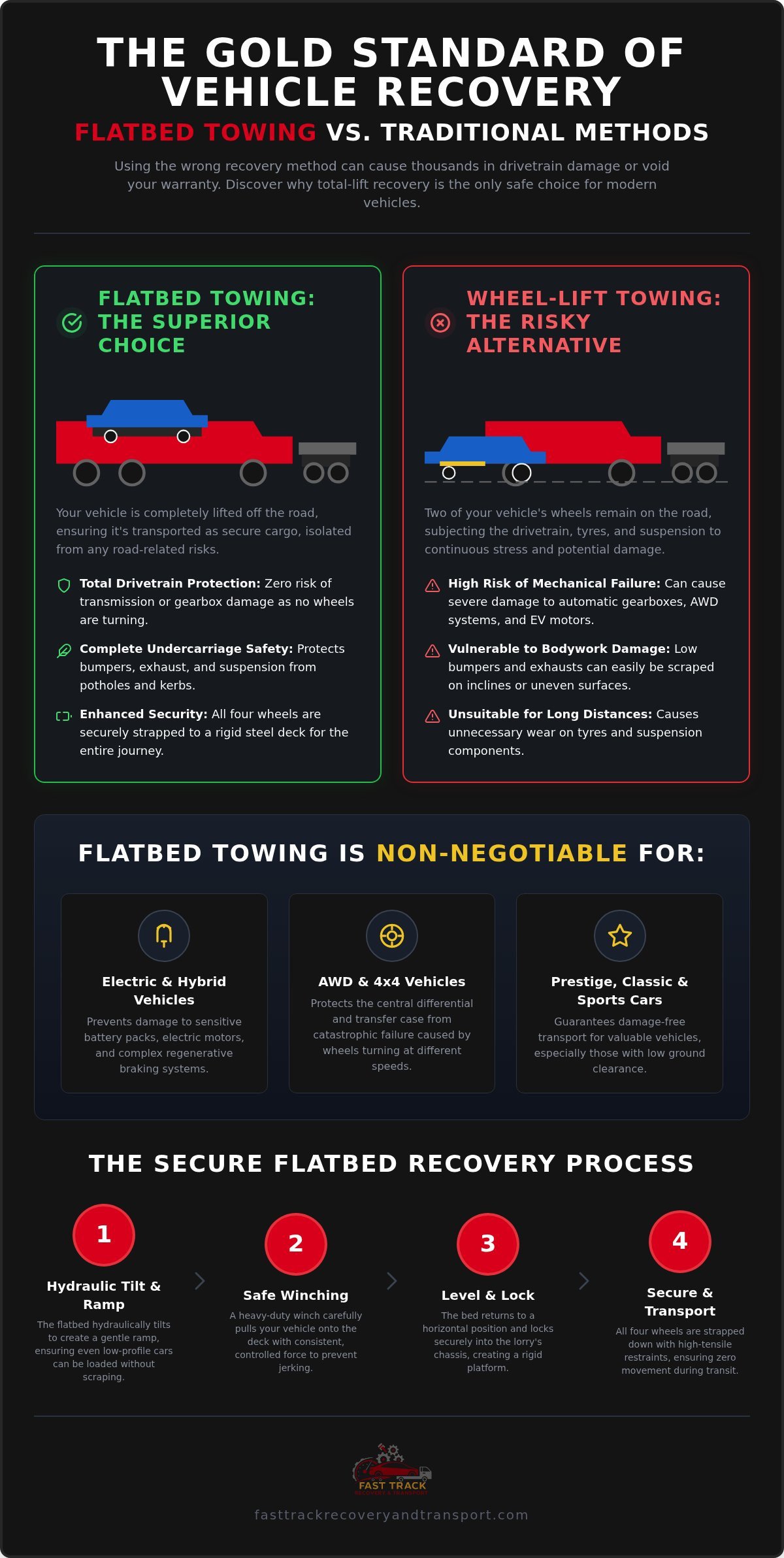
Traditional Towing often uses wheel-lift or “spectacle” cradles. These tools lift only the front or rear wheels, leaving the remaining tyres to roll along the ground. Whilst these are useful for tight spaces or short city hops, they’re often unsuitable for modern drivetrains. Flatbed towing is far superior for long-distance transport because it eliminates mechanical wear entirely. By keeping the vehicle entirely off the road surface, you avoid the heat buildup in the gearbox that occurs when wheels spin whilst the engine is off.
- Total suspension protection as the vehicle doesn’t hit potholes independently.
- Zero risk of transmission damage, especially in automatic or electric models.
- Prevention of bumper and undercarriage scrapes on uneven road surfaces.
- Enhanced security with all four wheels strapped directly to the steel deck.
It’s the most reliable way to ensure your car arrives at its destination in the exact same condition it was picked up in. Whether you’re moving a standard hatchback or a prestige classic, the stability of a flatbed platform is unmatched.
Flatbed vs. Wheel-Lift Towing: A Comparison
Choosing the right recovery method is about managing risk. Whilst wheel-lift towing remains a common sight on British roads, it’s vital to understand that it isn’t a one-size-fits-all solution. The primary difference lies in how your vehicle interacts with the road. In a wheel-lift scenario, two of your tyres remain in contact with the tarmac, spinning as the recovery truck moves. With flatbed towing, your car is entirely isolated from the road surface. This distinction is the difference between a simple transport job and potential mechanical heartbreak.
Safety levels vary significantly based on your vehicle type. For a standard front-wheel-drive hatchback, a short wheel-lift tow might be acceptable. However, for anything more complex, the risks multiply. Bumper and undercarriage damage are constant concerns with traditional lifts. If the recovery operator encounters a steep incline or a large pothole, the low-hanging parts of your car are vulnerable. A flatbed eliminates this worry by providing a static, level platform that keeps your bodywork well away from the ground.
When Wheel-Lift is Appropriate
There are specific scenarios where a traditional wheel-lift is actually the preferred tool. Urban centres with narrow lanes or tight corners often make it difficult for a large flatbed lorry to manoeuvre. Multi-storey car parks are another primary use case. Because flatbed lorries have a significant height clearance requirement to operate their hydraulic decks, they often cannot enter basement or covered parking structures. In these instances, a smaller wheel-lift vehicle is the only way to extract a stranded car. You’ll also see these used frequently for parking enforcement or quick repossessions where speed and agility in tight spaces are the priority.
The Superior Protection of Flatbed Recovery
For almost every other situation, flatbed towing is the superior choice. It provides total suspension for the vehicle, which is the only way to guarantee zero transmission wear. This is particularly critical for long-distance transport. If you’re moving a car across the country, you don’t want the drivetrain components moving for hundreds of miles without the engine running to provide lubrication.
Flatbeds also offer a shield against road debris. When a car is lifted by its wheels, it’s susceptible to stones and grit flicked up by the recovery truck’s rear tyres. On a flatbed, the car sits high and secure. This method is also the only viable option for accident-damaged vehicles. If a collision has caused seized wheels or a bent axle, a wheel-lift simply won’t work. If you’re currently facing a complex recovery, you can get an instant quote for a professional flatbed service to ensure your vehicle is handled with the care it deserves.
When is Flatbed Towing Strictly Required?
Modern vehicle engineering has made cars more efficient, but it has also made them more sensitive to improper handling. For many drivers, the choice of recovery method is dictated by the vehicle’s manual rather than personal preference. Ignoring these requirements doesn’t just cause minor wear; it can lead to catastrophic mechanical failure that insurers may refuse to cover. Why take that risk? Flatbed towing ensures that your car’s complex systems remain completely dormant whilst in transit. If you don’t have an existing membership or policy, it’s worth knowing that car recovery without breakdown cover is a straightforward option that gives you access to professional flatbed services on demand.
Electric Vehicles (EVs) and Hybrids
Recovering an electric vehicle requires specialist knowledge. Unlike traditional petrol cars, many EVs don’t have a true “neutral” gear that fully disconnects the electric motors from the wheels. If you tow an EV with its wheels on the road, the motor continues to turn, generating electricity. Without the car’s cooling systems active, this energy has nowhere to go, potentially destroying the inverter or the battery pack. Safety protocols for motorway breakdowns now mandate total-lift recovery to prevent these expensive thermal events. It’s the only way to ensure the delicate electronics stay protected.
All-Wheel Drive (AWD) and 4×4 Systems
AWD systems are designed to distribute power to all four wheels simultaneously. When you lift only two wheels, the centre differential tries to compensate for the speed difference between the moving and stationary axles. This creates immense friction and heat within the transmission. Is a short five-mile tow worth a gearbox rebuild? Absolutely not. Many manufacturers explicitly state that their vehicles must only be moved via flatbed towing to protect the integrity of the drivetrain. Even “just a short distance” can cause permanent damage to the internal clutches and gears.
Prestige, Classic, and Low-Profile Cars
Low ground clearance presents a physical barrier to traditional recovery. If your car has a front spoiler, a rear diffuser, or lowered suspension, a wheel-lift cradle will likely crush the bodywork before the car even moves. We use the shallow ramp angle of a rollback deck to avoid “nose-in” damage entirely. To protect expensive alloy wheels, we employ soft-tie strapping techniques that secure the vehicle by its tyres rather than the metal rims. This level of care is why auction collections and MOT drop-offs for high-value vehicles are almost exclusively handled by flatbeds. It’s about providing the high-stakes reliability that prestige owners expect.
The Flatbed Recovery Process: What to Expect
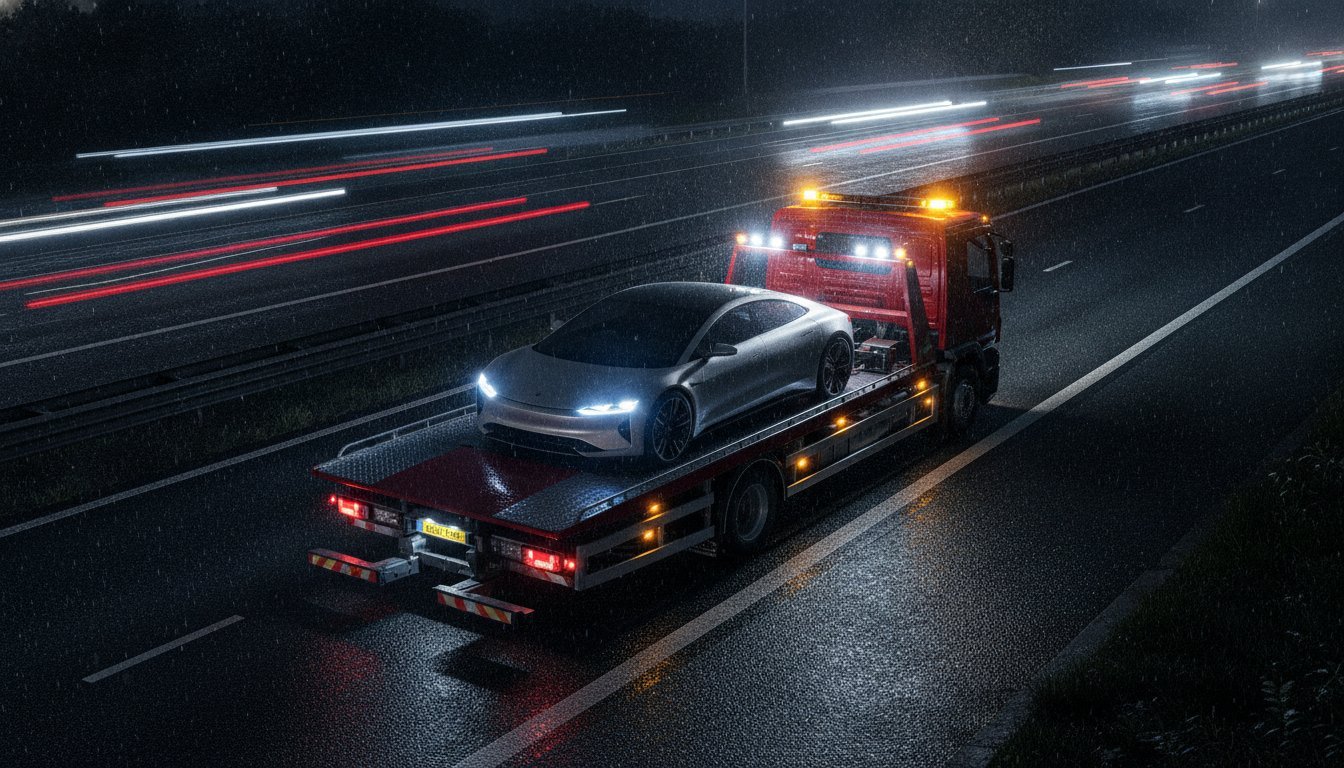
The moment you see the amber lights of a recovery vehicle, the weight of a breakdown begins to lift. A professional recovery isn’t just about moving a car; it’s a structured sequence designed to guarantee your safety and the integrity of your vehicle. The process begins with your initial call. We gather specific details about your location and vehicle type to ensure the correct equipment arrives. Clear communication is the foundation of our service. You’ll receive updates on the driver’s arrival time, providing proactive relief in a high-stress situation.
When the driver arrives, they take complete charge of the scene. Your only job is to stay safe whilst the expert manages the logistics. This methodical approach ensures that a roadside failure is resolved without further incident or damage to your car or van.
Preparation and Safety Checks
Safety is the primary focus before any machinery is operated. If you’re on a busy A-road or a motorway, the driver will position the recovery lorry in a “fend-off” position. This creates a physical barrier between passing traffic and the recovery zone. In line with UK motorway safety protocols, you and your passengers should wait behind the crash barrier, well away from the carriageway. The driver then performs a rapid assessment of your vehicle. They look for fluid leaks, seized wheels, or structural damage that might affect the loading process. By securing the area first, we ensure a controlled environment for the flatbed towing procedure.
Loading and Securing the Vehicle
Once the area is secure, the driver operates the hydraulic system to lower the bed to the tarmac. If your vehicle is a non-runner, they’ll locate the manufacturer’s designated towing eye and attach a heavy-duty winch cable. The winching process is slow and controlled. The driver monitors the clearance of your bumpers and undercarriage as the car moves up the ramp. This is where the shallow angle of the rollback deck proves its worth, especially for lower vehicles.
After the vehicle is positioned on the deck, the driver implements a four-point wheel strapping system. Each tyre is independently secured using high-tenacity tension belts. This is a crucial step; it ensures the car is held by its wheels rather than the chassis, preventing damage to brake lines or suspension components. Before departing, the driver performs a final walk-around to check the hydraulic locks and ensure all lighting is visible. If you’re currently stranded and need a professional response, book your flatbed recovery now for a secure, damage-free journey to your destination.
Professional National Recovery with Fast Track
When you’re stranded, you need a provider that operates with national scale and uncompromising consistency. Fast Track Recovery & Transport offers the steady confidence of a large-scale operation combined with the expert care of a specialist. We maintain 24/7 national availability, ensuring that help is never out of reach, regardless of the time or day. This reliability provides the proactive relief you need when a journey is interrupted by a breakdown or an accident.
Our fleet is equipped to handle more than just standard hatchbacks. We operate specialised flatbed towing vehicles capable of recovering everything from light vans to heavy goods vehicles (HGVs). We also possess the technical expertise required for EV recovery, ensuring that high-voltage battery systems are handled according to strict safety standards. By choosing a national provider, you guarantee that the same high level of professional handling is applied to your vehicle, whether you’re on a local A-road or a distant motorway. If you’re weighing up your options and want to understand the full cost of professional flatbed recovery, our guide on how much does car recovery cost UK breaks down every factor that affects your final bill.
24/7 Emergency Support Across the UK
Breakdowns don’t follow a schedule. Whether it’s a late-night motorway failure or a complex accident recovery, we respond with high-stakes urgency. Our team is trained in winch and recovery tasks for vehicles that have left the carriageway or become bogged down. This level of proficiency provides the peace of mind you need when a situation feels out of control. We arrive, take charge, and resolve the problem with the efficiency that only a seasoned professional can provide. You don’t have to manage the chaos; we do it for you.
Beyond Towing: Logistics and Storage
Our services extend beyond emergency roadside assistance. We manage scheduled logistics with the same gold-standard care, including auction collections and MOT pickup and drop-off services. If you’ve purchased a vehicle online or need a car moved whilst you’re at work, our team handles the transport with total precision. If your vehicle cannot be taken home or to a garage immediately, we offer secure vehicle storage options. Your asset remains protected in a monitored environment until you’re ready for the next step. Our goal is to move you from a state of vulnerability to a state of resolution as quickly as possible. Get an instant quote for professional flatbed towing today.
Secure Your Vehicle with Professional Recovery
Choosing the right recovery method is the difference between a minor setback and a mechanical disaster. You now understand why flatbed towing is the essential standard for modern EVs, AWD systems, and prestige vehicles. It’s the only way to guarantee that your car’s drivetrain remains protected whilst in transit. Why settle for anything less than total-lift security when your vehicle’s integrity is on the line? A professional approach ensures your car or van is handled with the technical precision it deserves.
Fast Track Recovery & Transport provides the proactive relief you need during a crisis. Our 24/7 national emergency recovery service means that expert help is always available, regardless of your location. We are specialists in EV and classic car transport, employing fully insured and professional recovery operators who take complete charge of the situation. We focus on movement, safety, and a quick resolution so you can focus on what comes next.
Don’t leave your vehicle’s safety to chance. Request an Instant Quote for Flatbed Recovery today and experience a dependable, expert service. We’re ready to help you get back on track with confidence and ease.
Frequently Asked Questions
Is flatbed towing more expensive than traditional towing?
Flatbed services typically carry a higher fee than wheel-lift methods because the equipment is more complex and the loading process requires more precision. Whilst the initial cost is higher, it often saves you money by preventing expensive transmission or bodywork repairs. We calculate fees based on the vehicle type and distance travelled. It’s the gold standard for avoiding the hidden costs of accidental damage during transit.
Can all cars be towed using a flatbed lorry?
Almost every passenger vehicle, from low-profile sports cars to large SUVs, can be recovered using flatbed towing. The hydraulic deck lowers to the ground, creating a shallow ramp that accommodates vehicles with minimal ground clearance. If your car has a long overhang or modified suspension, this is the only safe way to load it. Our fleet also includes specialised equipment for larger vans and HGVs, ensuring we can handle any vehicle size safely.
How long does it take to load a car onto a flatbed?
A standard recovery typically takes between 15 and 20 minutes to load and secure properly. This includes the time taken to position the recovery lorry, lower the hydraulic bed, winch the vehicle up, and apply four-point wheel strapping. If the vehicle is in a difficult position or has seized wheels, the process may take slightly longer. We prioritise safety over speed to ensure your vehicle is perfectly balanced and locked for the journey.
Is flatbed towing necessary for a front-wheel-drive car?
Whilst not strictly mandatory for short urban hops, flatbed towing is highly recommended for any significant distance. Even in front-wheel-drive cars, leaving the rear wheels on the road exposes the suspension and tyres to unnecessary wear and road debris. For modern vehicles with complex electronics and driver assistance systems, total-lift recovery is the most reliable way to ensure no sensors or mechanical components are stressed whilst the engine is off.
What happens if my car is stuck in gear or the handbrake is seized?
If your vehicle cannot roll, we use specialised equipment like wheel skates or a heavy-duty winch to move it onto the bed. Traditional towing is impossible if the wheels won’t turn, as dragging the car would destroy the tyres and drivetrain. Our operators are experts in winch and recovery tasks, allowing us to safely lift a locked vehicle without causing further mechanical damage. This is a common requirement for accident recovery.
Can you recover a van or a large SUV on a flatbed?
Yes, our fleet includes heavy-duty flatbeds specifically designed for larger loads like commercial vans and 4×4 SUVs. These vehicles often have a higher centre of gravity and greater weight, requiring a platform that can provide total stability during transit. We also offer specialised HGV recovery for even larger commercial vehicles. Whatever the size of your vehicle, we ensure it is fully supported and secured using industry-standard tension belts before we depart.
Is my vehicle insured whilst it is on the flatbed?
Your vehicle is fully insured from the moment our operator begins the loading process until it is safely offloaded at your destination. We employ professional recovery operators who follow strict safety protocols to minimise risk. This comprehensive coverage provides proactive relief, knowing that your asset is protected against any unforeseen incidents during transport. Always ensure your recovery provider is fully insured before allowing them to lift your car or van.
Do I need to be with the vehicle during the recovery process?
Ideally, you should be present to sign the recovery paperwork and hand over the keys. However, we understand that emergencies happen. If you cannot stay with the vehicle, especially on a dangerous motorway stretch, we can arrange to collect the keys from a safe location or a third party. Your safety is our primary concern. If you’re on a motorway, always wait behind the crash barrier as per UK safety protocols.
One Comment
[…] rise of electric cars has fundamentally changed the recovery landscape. For most EVs, flatbed towing is a non-negotiable requirement. Towing an EV with its wheels on the road can generate electricity […]